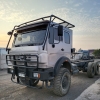
Mercedes 2626 AK 6x6
Moderator: Moderatoren
Re: Mercedes 2626 AK 6x6
Hello again, guys:
Hmm…maybe a book might not be a good idea, at the moment. Let’s see if I finish this thing before.
Anyway, thanks for the encouragement, Härry and Marcus.
Well, it has been a very busy time in regards of my regular job. And… harder times ahead.
The winter arrived, as every year, although this has been a very mild season, so far. Pretty cold days mingled with rain and a pale sun shining low on the horizon.
Inside the shop, while it rained outside, the work turned hectic when Ramón, Gabriel and I were all three working simultaneously with steel and throwing smoke and sparks all around. The bikes had to be carefully covered to avoid any damage from the sparks. It was a noisy mess, but it was necessary.
From the metal sheets collected at Verardo’s workshop I extracted some pieces needed for the brackets of the subframe. I decided to put to the test the whole thing before building it seriously, so I drilled 8 milimeters holes to let the structure lean on such delicate pivots to see if they held. In that case it would be apparent that the actual pivoting points of the frame were the exact ones, and I could go for the serious building from then on.
As part of the ceremony, it took me quite a while to align perfectly the pieces and to clamp them to the frame and the subframe.
Seems I got inadvertently another dog to grow the crowd.
The rear crossmember had to be the last to be welded to the subframe as it had to be precisely aligned with the crossmember bolted to the frame of the truck, and that meant that the central pivots should be stable, and so its installation had to be left for a later moment.
Gathered the M14 bolts and nuts I collected during all these years to select the better ones to use in the making and bolting of the crossmembers, and it was quite a lot although they were all too short. Hmm…
I was at it when Gabriel told me that there were a few cracks on the paint of the walls of the house that had to be dealt with, and as he and Ramón would not be available during the next days, it was Pairoa the one that had to deal with the issue, and quickly, as the forecast menaced with another rainy weekend. It was necessary to seal the cracks on the walls and re-paint the whole house.
So, I went out to buy a long, long, long telescopic ladder as it was not possible to use the tricky ladder I momentarily assembled for dealing with the panels and the manual winch of the roof of the shop once upon a time.
I spent that afterrnoon and the whole next morning at the task of repairing the supposedly infallible covering of the walls, applying a lot of urethane compound to seal the cracks that would have allowed the water to come in and cause catastrophic damage to the wooden panels the house was built with. Painting would have to wait.
And it rained, of course. And then the ice came, but fortunately it was not that bad, though the warning sign of the bike did not stop blinking while going from home to my job. Praise BMW for the heated motorcycle grips.
The sun shone at times warming the earth and the hearts, and Ramón went on with the roof of the kennel, dressed up like an only child under his welding gear to keep up with the cold of the evening.
Hmm…maybe a book might not be a good idea, at the moment. Let’s see if I finish this thing before.
Anyway, thanks for the encouragement, Härry and Marcus.
Well, it has been a very busy time in regards of my regular job. And… harder times ahead.
The winter arrived, as every year, although this has been a very mild season, so far. Pretty cold days mingled with rain and a pale sun shining low on the horizon.
Inside the shop, while it rained outside, the work turned hectic when Ramón, Gabriel and I were all three working simultaneously with steel and throwing smoke and sparks all around. The bikes had to be carefully covered to avoid any damage from the sparks. It was a noisy mess, but it was necessary.
From the metal sheets collected at Verardo’s workshop I extracted some pieces needed for the brackets of the subframe. I decided to put to the test the whole thing before building it seriously, so I drilled 8 milimeters holes to let the structure lean on such delicate pivots to see if they held. In that case it would be apparent that the actual pivoting points of the frame were the exact ones, and I could go for the serious building from then on.
As part of the ceremony, it took me quite a while to align perfectly the pieces and to clamp them to the frame and the subframe.
Seems I got inadvertently another dog to grow the crowd.
The rear crossmember had to be the last to be welded to the subframe as it had to be precisely aligned with the crossmember bolted to the frame of the truck, and that meant that the central pivots should be stable, and so its installation had to be left for a later moment.
Gathered the M14 bolts and nuts I collected during all these years to select the better ones to use in the making and bolting of the crossmembers, and it was quite a lot although they were all too short. Hmm…
I was at it when Gabriel told me that there were a few cracks on the paint of the walls of the house that had to be dealt with, and as he and Ramón would not be available during the next days, it was Pairoa the one that had to deal with the issue, and quickly, as the forecast menaced with another rainy weekend. It was necessary to seal the cracks on the walls and re-paint the whole house.
So, I went out to buy a long, long, long telescopic ladder as it was not possible to use the tricky ladder I momentarily assembled for dealing with the panels and the manual winch of the roof of the shop once upon a time.
I spent that afterrnoon and the whole next morning at the task of repairing the supposedly infallible covering of the walls, applying a lot of urethane compound to seal the cracks that would have allowed the water to come in and cause catastrophic damage to the wooden panels the house was built with. Painting would have to wait.
And it rained, of course. And then the ice came, but fortunately it was not that bad, though the warning sign of the bike did not stop blinking while going from home to my job. Praise BMW for the heated motorcycle grips.
The sun shone at times warming the earth and the hearts, and Ramón went on with the roof of the kennel, dressed up like an only child under his welding gear to keep up with the cold of the evening.
Re: Mercedes 2626 AK 6x6
At my request he inspected the crossmembers I was building and suggested to reinforce them with additional steel, even if it seemed that it was okay. It never harms to be on the ultra safe side.
I followed his advice and went on with the building of the front crossmember. This piece would go gripped to the upper upper flange of the frame beams of the truck by bolt-driven brackets. The design of the brackets was a little tricky and I wanted to make them very tough and precise though easy to install.
Working with 8 mm-thick steel was relatively straight forward, as to cut and weld it was easy and with not too much heat deformation, but still there was some, which made the process a little boring as some corrections with lime and powergrinding on the brackets were needed.
I thought I reinforced them enough to withstand the forces they should resist, and much more, you know… that Godzilla stuff. I was happy with how they looked and how they worked, in the end.
A few days passed and I could not touch the pieces because I had no time left, and a new cargo of steel tubes and profiles came and were prepared to be used in the roof of the kennel and to rebuild the gate of the entrance. Ops.
There was one thing that bothered me since I reviewed some of the pictures when I declared the Merkabah, the truck, ready: the headlights. They looked so pale, and they did not illuminate too much.
I made a quick stop at the classic tool shop, and I spotted some LED lamps in the display cabinet, and they had 12-24V written on the side of the box. I got a pair and later, on arrival, made a test by swapping only the left headlamp. The difference was quite noticeable, so I put the new LED lamp on the other side too and went in for dinner.
Eduardo warned me that there would probably be some interference with the radio reception due to the LED lights, but I would have to wait before finding out.
And the cold and the rain and a little snow went on, cleaning the atmosphere and giving beautifull views of the countryside and the nearby mountains that I love so much.
I followed his advice and went on with the building of the front crossmember. This piece would go gripped to the upper upper flange of the frame beams of the truck by bolt-driven brackets. The design of the brackets was a little tricky and I wanted to make them very tough and precise though easy to install.
Working with 8 mm-thick steel was relatively straight forward, as to cut and weld it was easy and with not too much heat deformation, but still there was some, which made the process a little boring as some corrections with lime and powergrinding on the brackets were needed.
I thought I reinforced them enough to withstand the forces they should resist, and much more, you know… that Godzilla stuff. I was happy with how they looked and how they worked, in the end.
A few days passed and I could not touch the pieces because I had no time left, and a new cargo of steel tubes and profiles came and were prepared to be used in the roof of the kennel and to rebuild the gate of the entrance. Ops.
There was one thing that bothered me since I reviewed some of the pictures when I declared the Merkabah, the truck, ready: the headlights. They looked so pale, and they did not illuminate too much.
I made a quick stop at the classic tool shop, and I spotted some LED lamps in the display cabinet, and they had 12-24V written on the side of the box. I got a pair and later, on arrival, made a test by swapping only the left headlamp. The difference was quite noticeable, so I put the new LED lamp on the other side too and went in for dinner.
Eduardo warned me that there would probably be some interference with the radio reception due to the LED lights, but I would have to wait before finding out.
And the cold and the rain and a little snow went on, cleaning the atmosphere and giving beautifull views of the countryside and the nearby mountains that I love so much.
Re: Mercedes 2626 AK 6x6
Finally, I had some time to take the crossmember and made some reinforcements here and there until it was ready to be mounted. I went to a rubber-to-metal bonding workshop that I used to go before and got some pieces of high-density rubber for the brackets from the owner who, after some years, still remembered the project I was in.
I took the welder to the side of the Merkabah again and tack welded all the pieces held until then by the C-clamps. I measured it all again making sure it was all still aligned and straight.
Late in the evening I installed, momentarily but perfectly aligned, the front crossmember on the frame. I had to move the brake servo pump to make room for the bracket to be applied, as it stood in the way. It should not have been a big deal, but now the access was pretty difficult with all this metallic stuff hiding it from sight and reach.
One of the reasons the design of the rubber mounted subframe was abandoned was the fact that the access from the side of the truck to the stuff in between the rails would have been completely blocked, making repairs, inspections or servicing pretty difficult.
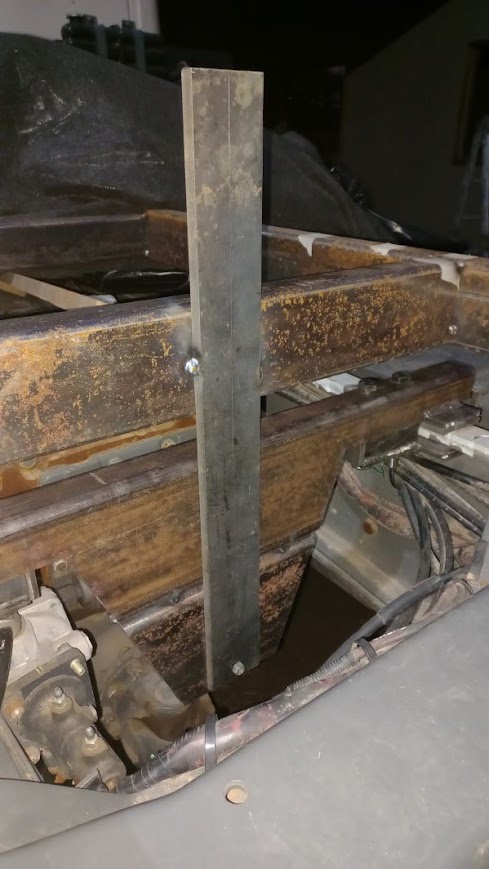
Finally, with the subframe fixed to the frame by the central pivots, I aligned and tack welded also the rear crossmember that would hold the rear pivoting bracket.
It was pretty late and cold and Carmen went out and shouted some quite menacing words that I could not understand, but I got the message, so I took a quick picture to show the frame with no C-clamp attached to it, made order and went inside for a welcomed hot cup of tea.
The next weekend began by gathering the pieces I would need for cross lifting the axles to bend the frame and see, again, how it behaved.
I got the hydraulic jack and a lot of pieces of wood to play with, under the attentive look of Trump that missed not one of my movements.
I also borrowed from Marco, Eduardo’s cousin, an IBC tank to apply some load on the frame, as planned before.
After a couple of thousand strokes, I finally got the truck on a stump and a stand, twisted enough as to lift the right wheel of the third axle.
The longitudinal pivoting axles of the frame remained the same as measured while the Merkabah was on Eduardo’s workshop, far in the depths of the frame at both the front and the rear.
Sorry, but I cannot correct the orientation of the vertical pictures.
Eduardo gave me a hand, and we placed the water tank on the frame, right on the center of the boggie.
I took the welder to the side of the Merkabah again and tack welded all the pieces held until then by the C-clamps. I measured it all again making sure it was all still aligned and straight.
Late in the evening I installed, momentarily but perfectly aligned, the front crossmember on the frame. I had to move the brake servo pump to make room for the bracket to be applied, as it stood in the way. It should not have been a big deal, but now the access was pretty difficult with all this metallic stuff hiding it from sight and reach.
One of the reasons the design of the rubber mounted subframe was abandoned was the fact that the access from the side of the truck to the stuff in between the rails would have been completely blocked, making repairs, inspections or servicing pretty difficult.
Finally, with the subframe fixed to the frame by the central pivots, I aligned and tack welded also the rear crossmember that would hold the rear pivoting bracket.
It was pretty late and cold and Carmen went out and shouted some quite menacing words that I could not understand, but I got the message, so I took a quick picture to show the frame with no C-clamp attached to it, made order and went inside for a welcomed hot cup of tea.
The next weekend began by gathering the pieces I would need for cross lifting the axles to bend the frame and see, again, how it behaved.
I got the hydraulic jack and a lot of pieces of wood to play with, under the attentive look of Trump that missed not one of my movements.
I also borrowed from Marco, Eduardo’s cousin, an IBC tank to apply some load on the frame, as planned before.
After a couple of thousand strokes, I finally got the truck on a stump and a stand, twisted enough as to lift the right wheel of the third axle.
The longitudinal pivoting axles of the frame remained the same as measured while the Merkabah was on Eduardo’s workshop, far in the depths of the frame at both the front and the rear.
Sorry, but I cannot correct the orientation of the vertical pictures.
Eduardo gave me a hand, and we placed the water tank on the frame, right on the center of the boggie.
Re: Mercedes 2626 AK 6x6
I connected the water hose and began to fill the tank with the precious liquid we praise so much in the summertime.
As the filling rate was not very fast the evening came, and it became progressively darker and cooler. I did not want to make any measurements with the light of the phone, so I wrapped the whole thing and left for another cup of tea and a big glass of milk and banana.
The next day arrived with a bright sun and a clear sky. The Merkabah seemed not to protest her ballerina-like attitude and her unlikely coat.
And, of course, the measurements did not change a bit. Probably one or three tons would make no difference for a frame made to withstand 26 tons, so I took the numbers for certain and began the not very encouraging task of emptying the water tank and remove it and the stump and the stand from under the axles. Pretty boring.
Fortunately, the ¾ HP pump made emptying the tank much quicker and pretty clean. Unfortunately, the water went directly to the ditch.
After putting all the wheels on the ground, I took the crossmembers out and began the marking and the cutting to stretch them with other pieces of 150x50x5. But, again, it was late and cold, and I had many things to do in the next days.
The next morning, it was cold, really cold, at least for the local standards.
When taking the bike out of the shop, breathing heavily the chilling air, I put the brain at work and decided to put the subframe to the test before doing the serious welding and installing the definitive bushings. So, I would use other M8 bolts as longitudinal pivots and stress again the frame to see if they held. If they did, there would be absolutely no doubt that the measurements were the right ones and I would be able to put anything on the subframe an it would not suffer any shear force.
Re: Mercedes 2626 AK 6x6
When I could, I resumed the work and cut and drilled the rest of the pieces of the rear crossmember, tack welded them and tried to put the big and heavy thing in place. Unfortunately, the winch was in the middle, as expected when the pivot point was so deep down.


I unscrewed the winch and kicked it as back as I could. That gave the exact amount of space to place the crossmember and the head of the M8 bolt. I would think on how to fix the winch issue later.

Then, I repeated the operation with the front crossmember, which was only 27 cm deep and did not require an additional piece to get to that level.

Meanwhile, Gabriel was charged with the repairing and the painting of the the walls and the window frames of the house. In a fine gesture he covered the new ladder with plastic not to stain it with paint. As the maniac I am, it was really appreciated.

In the afternoon, I cranked the mighty V8 and waited for the air pressure to build up for levelling the frame of the Merkabah to align the crossmembers and the subframe perfectly again. Then, tack welded some long pieces of steel that would act like the front and rear brackets of the subframe.


Put just a couple of welds to fix them, with a long lever. In case there were still big stressful forces the weldings or the bolts would give. Then, wrapped the back of the truck and enjoyed a nice meal as the day came to its end.
The very next day, yesterday actually, my father paid us a visit after quite some time, and he accompanied me to the dry riverbed to see if the whole thing was able to tolerate some abuse without braking apart.
And the Merkabah once again went to play. I drove her to the same spot where she twisted to maximum. My old man had some difficulties going down the cabin because it was very high… and he is already 81. We are not the same at 81, guys.

The frame spiraled under the tension, much more than when jacked up, but the subframe kept perfectly straight.


Success. It was all okay. The weldings and the bolts stood and nothing broke.

The serious building could then begin.
I unscrewed the winch and kicked it as back as I could. That gave the exact amount of space to place the crossmember and the head of the M8 bolt. I would think on how to fix the winch issue later.
Then, I repeated the operation with the front crossmember, which was only 27 cm deep and did not require an additional piece to get to that level.
Meanwhile, Gabriel was charged with the repairing and the painting of the the walls and the window frames of the house. In a fine gesture he covered the new ladder with plastic not to stain it with paint. As the maniac I am, it was really appreciated.
In the afternoon, I cranked the mighty V8 and waited for the air pressure to build up for levelling the frame of the Merkabah to align the crossmembers and the subframe perfectly again. Then, tack welded some long pieces of steel that would act like the front and rear brackets of the subframe.
Put just a couple of welds to fix them, with a long lever. In case there were still big stressful forces the weldings or the bolts would give. Then, wrapped the back of the truck and enjoyed a nice meal as the day came to its end.
The very next day, yesterday actually, my father paid us a visit after quite some time, and he accompanied me to the dry riverbed to see if the whole thing was able to tolerate some abuse without braking apart.
And the Merkabah once again went to play. I drove her to the same spot where she twisted to maximum. My old man had some difficulties going down the cabin because it was very high… and he is already 81. We are not the same at 81, guys.
The frame spiraled under the tension, much more than when jacked up, but the subframe kept perfectly straight.
Success. It was all okay. The weldings and the bolts stood and nothing broke.
The serious building could then begin.
- macherknox
- abgefahren
- Beiträge: 1483
- Registriert: 2014-07-07 15:51:11
- Wohnort: Wedel
Re: Mercedes 2626 AK 6x6
Hi Pairo,
I'm following your work now for quite a while, great to see progress and you're only xxx away from the first camping trip.
Best regards
Max
I'm following your work now for quite a while, great to see progress and you're only xxx away from the first camping trip.
Best regards
Max
Re: Mercedes 2626 AK 6x6
Dear Pairo
I think you need a second fulcrum at the middle of the long sides of the frame (the sides form the front to the back of the vehicle) to avoid strain while twisting.
While twisting the main frame, one of the fixed point at the middle of the long sides will move forward and the other backwards.
This requires a lever with two pivot points in the middle oft the long sides of the frames .
Try in a little model first.
Then you will see how the levers work and move in different directions between the frames while Twisting the main frame.
Liebe Grüße
Oli
I think you need a second fulcrum at the middle of the long sides of the frame (the sides form the front to the back of the vehicle) to avoid strain while twisting.
While twisting the main frame, one of the fixed point at the middle of the long sides will move forward and the other backwards.
This requires a lever with two pivot points in the middle oft the long sides of the frames .
Try in a little model first.
Then you will see how the levers work and move in different directions between the frames while Twisting the main frame.
Liebe Grüße
Oli
- Pirx
- Säule des Forums
- Beiträge: 18573
- Registriert: 2006-10-04 20:03:38
- Wohnort: Raum Stuttgart
- Kontaktdaten:
Re: Mercedes 2626 AK 6x6
The concept described by Oli works well, but is not very common.landwerk hat geschrieben: ↑2025-07-07 15:40:15Dear Pairo
I think you need a second fulcrum at the middle of the long sides of the frame (the sides form the front to the back of the vehicle) to avoid strain while twisting.
While twisting the main frame, one of the fixed point at the middle of the long sides will move forward and the other backwards.
This requires a lever with two pivot points in the middle oft the long sides of the frames .
Try in a little model first.
Then you will see how the levers work and move in different directions between the frames while Twisting the main frame.
Liebe Grüße
Oli
Alternatively, the center pivots can stay fixed. But in that case, the front and rear pivots must enable a certain movement in longitudinal direction. Which, I think, you Pairoa already had in mind ...
Pirx
Der mit der Zweigangachse: 15 Vorwärtsgänge, 3 Rückwärtsgänge, Split, Schnellgang, Differentialsperre
---
"Immer bedenken: Hilfe ist keine Einbahnstrasse, Geholfen-Werden ist kein Recht und es liegt an jedem selbst, inwieweit er sich hier in der Gemeinschaft (die im Extremfall so einiges gemeinsam schafft) involviert und einbringt."
Ein Unimog-Fahrer.
---
"Immer bedenken: Hilfe ist keine Einbahnstrasse, Geholfen-Werden ist kein Recht und es liegt an jedem selbst, inwieweit er sich hier in der Gemeinschaft (die im Extremfall so einiges gemeinsam schafft) involviert und einbringt."
Ein Unimog-Fahrer.
Re: Mercedes 2626 AK 6x6
Hello again:
“xxx” seems the right time for the first camping indeed, Max. I only hope to still be able to go up and down the cabin.
“… While twisting the main frame, one of the fixed point at the middle of the long sides will move forward and the other backwards.
This requires a lever with two pivot points in the middle oft the long sides of the frames.”
“… the center pivots can stay fixed. But in that case, the front and rear pivots must enable a certain movement in longitudinal direction. Which, I think, you Pairoa already had in mind ... “.
Kind of, dear Klaus and Oli:
Placing the central pivots right on the center of the boggie console, the toughest and more rigid piece of the whole truck, minimizes their displacement, though they move, actually.
More elegant concepts include bigger and rubber-mounted central pivots to deal with this movement, but I wanted to keep the design as simple as possible, and I have seen a lot of examples of what works and what ends in disaster.
That is why I do not mind the pretty extensive length of the transversal plaques that will bond the Box to the subframe through the longitudinal pivot. I am counting on the slight bending capacity of those pieces to absorb the very tiny to and fro movement derived from the torsion of the frame. It is not much.
Also, Having a composite crossmember made from two or three pieces of rectangular steel profile may give the piece a little less rigidity compared with a solid one when talking about the longitudinal resistance, while keeping the strength.
Sounds right, though I cannot be 100% certain. That’s why I wanted to make a full test before, and it seems to work well… so far.
I will install the serious bushings (already ordered) and make another test. And when the metal frame of the base of the Box is ready, I will make another test, and so on ad nauseam, to see if things change in the making. Hope they do not.
Cheers and thanks for the feedback.
“xxx” seems the right time for the first camping indeed, Max. I only hope to still be able to go up and down the cabin.
“… While twisting the main frame, one of the fixed point at the middle of the long sides will move forward and the other backwards.
This requires a lever with two pivot points in the middle oft the long sides of the frames.”
“… the center pivots can stay fixed. But in that case, the front and rear pivots must enable a certain movement in longitudinal direction. Which, I think, you Pairoa already had in mind ... “.
Kind of, dear Klaus and Oli:
Placing the central pivots right on the center of the boggie console, the toughest and more rigid piece of the whole truck, minimizes their displacement, though they move, actually.
More elegant concepts include bigger and rubber-mounted central pivots to deal with this movement, but I wanted to keep the design as simple as possible, and I have seen a lot of examples of what works and what ends in disaster.
That is why I do not mind the pretty extensive length of the transversal plaques that will bond the Box to the subframe through the longitudinal pivot. I am counting on the slight bending capacity of those pieces to absorb the very tiny to and fro movement derived from the torsion of the frame. It is not much.
Also, Having a composite crossmember made from two or three pieces of rectangular steel profile may give the piece a little less rigidity compared with a solid one when talking about the longitudinal resistance, while keeping the strength.
Sounds right, though I cannot be 100% certain. That’s why I wanted to make a full test before, and it seems to work well… so far.
I will install the serious bushings (already ordered) and make another test. And when the metal frame of the base of the Box is ready, I will make another test, and so on ad nauseam, to see if things change in the making. Hope they do not.
Cheers and thanks for the feedback.
Re: Mercedes 2626 AK 6x6
Here is a picture of a MB original construction. I gues the movement of the levers was mor than 5 cm against each other:
userpix/182_10171_1.jpg
Liebe Grüße
Oli
userpix/182_10171_1.jpg
Liebe Grüße
Oli
Re: Mercedes 2626 AK 6x6
Hi again, Oli:
The original MB anti torsion subframe is a complicated piece, not very lightweight, and includes a torsion bar linked to the spring packs. It is a three pivot or triangular shaped system, which "fixed" or strong pivoting point is the rear one with a longitudinally rotating axle, and the lateral or transversal pivots are way on the front and they pivot in relation with both the subframe and with the upper structure, allowing plenty of movement in the aft-front direction.
The Casales offered me such device, taken from their 1017, that could have been modified, heavily modified, to fit the Merkabah, but would have been a real crime to ruin the piece.
The frame of the 1017 is also very different from the AK2626 and way more flexible than any stiff kipper-minded model.
The frame of the Merkabah does not move that much, and I am pretty confident that my anti torsion subframe design will deliver and endure. If not, you will be the first to know!
Greetings from the south.
The original MB anti torsion subframe is a complicated piece, not very lightweight, and includes a torsion bar linked to the spring packs. It is a three pivot or triangular shaped system, which "fixed" or strong pivoting point is the rear one with a longitudinally rotating axle, and the lateral or transversal pivots are way on the front and they pivot in relation with both the subframe and with the upper structure, allowing plenty of movement in the aft-front direction.
The Casales offered me such device, taken from their 1017, that could have been modified, heavily modified, to fit the Merkabah, but would have been a real crime to ruin the piece.
The frame of the 1017 is also very different from the AK2626 and way more flexible than any stiff kipper-minded model.
The frame of the Merkabah does not move that much, and I am pretty confident that my anti torsion subframe design will deliver and endure. If not, you will be the first to know!
Greetings from the south.
Re: Mercedes 2626 AK 6x6
Hi:
Not too many things to report today, because at this time of the year the regular work becomes a little hectic and the Merkabah is forced to the eternal waiting. And it really has been quite a special year this one.
Anyways, when I made the practical twisting test of the frame on the riverbed with my father, the construct behave as perfectly as calculated. I was so happy that I began to think in fabricating the metal frame for the base panel for the Box as soon as possible.
So, I rescued from the oblivion the jack stands that supported -barely- the load of 500 cement bags on the bed of the green Nissan truck. Some were a little bent for the effort, nothing that a loving trim with the powergrinder could not fix, but I wanted them to be adjustable to the millimeter in order to build the frame perfectly square and even.
Some big bolts and the correspondant nuts were then selected for the adjustability of the height and with a little cutting and welding I modified the stands to be up to the task, under the constant and proactive supervision of Trump, of course.


At some moment, I removed the pieces of the central bracket of the left side of the subframe and enlarged the perforations for the actual 5/16” pins and then welded the metal bushings prepared by Verardo’s people.


They came pretty good to me and, supposedly, each bracket could stand twice the weight of the whole Box.

It was late when I put them back in their place and tack welded them, again. Yes, they looked good.

And at some other moment, I removed the front and aft crossmembers and began to make the appropriate cuts, weldings and reinforcements to make them fully ready to use.


Not too many things to report today, because at this time of the year the regular work becomes a little hectic and the Merkabah is forced to the eternal waiting. And it really has been quite a special year this one.
Anyways, when I made the practical twisting test of the frame on the riverbed with my father, the construct behave as perfectly as calculated. I was so happy that I began to think in fabricating the metal frame for the base panel for the Box as soon as possible.
So, I rescued from the oblivion the jack stands that supported -barely- the load of 500 cement bags on the bed of the green Nissan truck. Some were a little bent for the effort, nothing that a loving trim with the powergrinder could not fix, but I wanted them to be adjustable to the millimeter in order to build the frame perfectly square and even.
Some big bolts and the correspondant nuts were then selected for the adjustability of the height and with a little cutting and welding I modified the stands to be up to the task, under the constant and proactive supervision of Trump, of course.
At some moment, I removed the pieces of the central bracket of the left side of the subframe and enlarged the perforations for the actual 5/16” pins and then welded the metal bushings prepared by Verardo’s people.
They came pretty good to me and, supposedly, each bracket could stand twice the weight of the whole Box.
It was late when I put them back in their place and tack welded them, again. Yes, they looked good.
And at some other moment, I removed the front and aft crossmembers and began to make the appropriate cuts, weldings and reinforcements to make them fully ready to use.
Re: Mercedes 2626 AK 6x6
After many weeks without any news, finally the dealer of the servo clutch sent an email granting a reimbursement for the part I gave back to them as it was, of course, irreparable. My usual luck.
So, I went to Santiago and purchased another one but profited of a special sale and got an original Wabco servo clutch for half the original price minus the price of the Cojali crap. Lesson learned.

I tested if the thing worked before taking it out of the shop, but only when I was at home the next day, and after bolting the servo to the support, I found out that the fitting had the wrong thread. Ops.

What to do? Put it in the pocket and drift to another issue. Life is hard.
The crossmembers needed some more attention so I finished the work on them. I trimmed the sides of the front one a little, and carefully welded lateral reinforcements and, of course, welded the bushings.


Slowly but surely, with his ennervant precision, Ramón approached the finish point with the roofing of the kennel. It would be capable of supporting a few dozen more solar panels, a heliport or the fith chimney of the Titanic.

From the rest of the big metal plate that was left, I cut one of the plates of the front bracket of the subframe. It was one big heavy piece. Originaly, the design featured an odd shape and many funny carved holes to keep it strong but light.
F..ck it; keep it plain and simple.

Yet, to cope with the limited but sure back and forth movement, I needed some play to avoid the direct conflict of the plates with the crossmember, so I added in the design an inner washer and the correspondant supple to keep the parallelism of the plate with the subframe’s crossmember.

This time Trump and Alicia made turns to control the operation and give the appropriate orders and directions to the subscriber.

The rest of the crew did not bother too much and remained distant, aware of the burning sparks and busy with their own metaphysical self-imposed tasks.

I put the front crossmember and the half bracket plate in place and it all fitted perfectly. I put a couple of tack welds and went inside to change clothes as it was someone’s birthday, and that took all my attention for the rest of the day.

So, I went to Santiago and purchased another one but profited of a special sale and got an original Wabco servo clutch for half the original price minus the price of the Cojali crap. Lesson learned.
I tested if the thing worked before taking it out of the shop, but only when I was at home the next day, and after bolting the servo to the support, I found out that the fitting had the wrong thread. Ops.
What to do? Put it in the pocket and drift to another issue. Life is hard.
The crossmembers needed some more attention so I finished the work on them. I trimmed the sides of the front one a little, and carefully welded lateral reinforcements and, of course, welded the bushings.
Slowly but surely, with his ennervant precision, Ramón approached the finish point with the roofing of the kennel. It would be capable of supporting a few dozen more solar panels, a heliport or the fith chimney of the Titanic.
From the rest of the big metal plate that was left, I cut one of the plates of the front bracket of the subframe. It was one big heavy piece. Originaly, the design featured an odd shape and many funny carved holes to keep it strong but light.
F..ck it; keep it plain and simple.
Yet, to cope with the limited but sure back and forth movement, I needed some play to avoid the direct conflict of the plates with the crossmember, so I added in the design an inner washer and the correspondant supple to keep the parallelism of the plate with the subframe’s crossmember.
This time Trump and Alicia made turns to control the operation and give the appropriate orders and directions to the subscriber.
The rest of the crew did not bother too much and remained distant, aware of the burning sparks and busy with their own metaphysical self-imposed tasks.
I put the front crossmember and the half bracket plate in place and it all fitted perfectly. I put a couple of tack welds and went inside to change clothes as it was someone’s birthday, and that took all my attention for the rest of the day.
Re: Mercedes 2626 AK 6x6
Remember the wrong fitting, the quick connector of the servo clutch? Well, not surprisingly there was no adaptor available, so I took it to a professional turner and asked him to make it the adaptor itself, with a sample of the fitting that the Merkabah had.
A few days later he delivered, a couple of days past the day he promised to deliver, of course, but I came home late with the solution of the clutch issue in my hands. Good.

That same afternoon I found the big surprise that Mr. Johnson, the solar guy, had for me. He came to check the system as the electricity bill during the month of June was exceptionally high. Too much demand coupled with weaker generation with a less than optimal battery capacity was the final diagnosis. It sounds simple but it was really not that simple.
Anyways, given that I am an exceptional customer, with an exceptionally bad luck regarding hardware of any given sort, shape and form, he took the two “little” intelligent lithium ion batteries that did not work with the past configuration of the system and brang a massive one with four times their capacity and, obviously, much more capacity than the AGM batteries currently in use, with the difference in price totally on him.

I said: why not? And so, we agreed.
The very next day, I tried to connect the hydraulic line to the servo clutch and, guess what: the guy made the work perfectly, but the sample was longer than the actual fitting of the Merkabah for a couple of millimeters, so it did not fit. Hmm…

The solution: the powergrinder! A neat cut and some fine grinding and it was done. Yes, perfect fit.


Now I only needed to wait for Eduardo to help me to bleed the circuit, which could take a few days as we were both working hard and late.
Meanwhile, I removed the pieces of the bracket of the right side of the subframe and repeated the operation of fitting and welding the bushings and then I took the welder outside to tack weld them in place.


Unfortunately, the uneven terrain played some tricks and despite the precautions the chain latch support of the argon tube broke, and it was not longer safe to keep it on the machine. As I was not keen on fixing it again, I wanted to keep making some progress with the project, I just fixed it to the ground with the trestles and some pieces of steel and clamps. And so be it, until I was in the mood to disassemble the welder again.

My good friend Verardo had also a gift, and he gave me a big 8 mm steel plate that he had at some corner of his machine shop. I struggled a little with the piece as my back had protested a few times after carrying Pity the pitbull when she was operated on a few tumors she had on her skin a few weeks before.
She looked at the plate like she was comparing her weight to it, ready for a comment that, fortunately, never came.

As soon as I could I put my hands to mark the steel plate to cut the big pieces for the front and aft brackets that still were needed, with renewed energies, same as Trump.

A few days later he delivered, a couple of days past the day he promised to deliver, of course, but I came home late with the solution of the clutch issue in my hands. Good.
That same afternoon I found the big surprise that Mr. Johnson, the solar guy, had for me. He came to check the system as the electricity bill during the month of June was exceptionally high. Too much demand coupled with weaker generation with a less than optimal battery capacity was the final diagnosis. It sounds simple but it was really not that simple.
Anyways, given that I am an exceptional customer, with an exceptionally bad luck regarding hardware of any given sort, shape and form, he took the two “little” intelligent lithium ion batteries that did not work with the past configuration of the system and brang a massive one with four times their capacity and, obviously, much more capacity than the AGM batteries currently in use, with the difference in price totally on him.
I said: why not? And so, we agreed.
The very next day, I tried to connect the hydraulic line to the servo clutch and, guess what: the guy made the work perfectly, but the sample was longer than the actual fitting of the Merkabah for a couple of millimeters, so it did not fit. Hmm…
The solution: the powergrinder! A neat cut and some fine grinding and it was done. Yes, perfect fit.
Now I only needed to wait for Eduardo to help me to bleed the circuit, which could take a few days as we were both working hard and late.
Meanwhile, I removed the pieces of the bracket of the right side of the subframe and repeated the operation of fitting and welding the bushings and then I took the welder outside to tack weld them in place.
Unfortunately, the uneven terrain played some tricks and despite the precautions the chain latch support of the argon tube broke, and it was not longer safe to keep it on the machine. As I was not keen on fixing it again, I wanted to keep making some progress with the project, I just fixed it to the ground with the trestles and some pieces of steel and clamps. And so be it, until I was in the mood to disassemble the welder again.
My good friend Verardo had also a gift, and he gave me a big 8 mm steel plate that he had at some corner of his machine shop. I struggled a little with the piece as my back had protested a few times after carrying Pity the pitbull when she was operated on a few tumors she had on her skin a few weeks before.
She looked at the plate like she was comparing her weight to it, ready for a comment that, fortunately, never came.
As soon as I could I put my hands to mark the steel plate to cut the big pieces for the front and aft brackets that still were needed, with renewed energies, same as Trump.
Re: Mercedes 2626 AK 6x6
I made a picture of the 10th cutting disc that I had used in just a couple of days. Though it is a boring process, I always prefer to cut the pieces by myself. If not, what is the fun?

To avoid overheating the power grinders I worked with both of them alternatively, with the gates of the shop widely open to keep the fresh air coming.
Fortunately, my neighbor is a welder and makes his living on it, so I bother no one with all the noise as he himself competes with me with the use of the welder and the machines in the weekends.

It took me a while, but I cut and finished the three pieces for the brackets and I decided to install the rear ones first, and there was a reason for that.

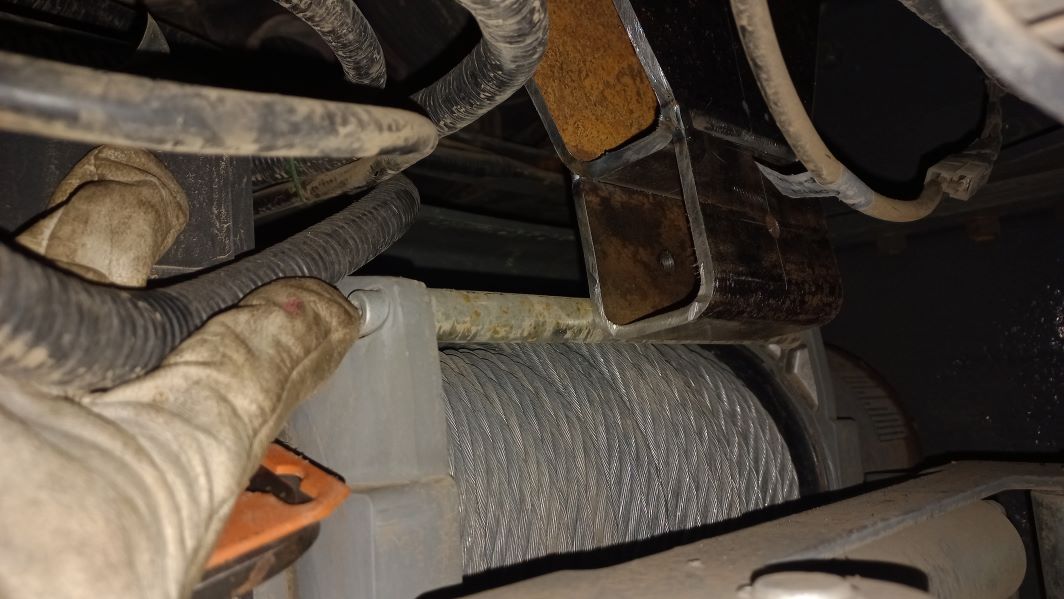
Remember that the rear bracket was so long that there was a neat conflict with the winch, and it was not just a matter of moving it a little? Well, it was just the right time to address the issue.
When put in position, the bracket plate made clear that some radical move had to be made. I decided then that the easier way was to put supples and lower the whole winch tray just the exact amount to clear the upper tie bar of the winch not to compromise the departure angle too much. You know I care about it because I always put myself in trouble and more than surely it will be meaningful in the future.

The recently modified jack stands worked perfectly to lower the quite heavy tray, though it was difficult to move under the frame with so many kissing attacks.

When measured, only 3,5 cm of clearance were needed, good, but I had got to make a couple of ad hoc supples from what I could find without deviating too much from the main goal.
I immediately put my eyes on the 150x50x5 profile and made some calculations. The numbers, roughly, as my skills and knowledge are pretty limited on the matter, turned.
So, I cut and shaped a couple of supples made from the said profile and some nice weldings.


To avoid overheating the power grinders I worked with both of them alternatively, with the gates of the shop widely open to keep the fresh air coming.
Fortunately, my neighbor is a welder and makes his living on it, so I bother no one with all the noise as he himself competes with me with the use of the welder and the machines in the weekends.
It took me a while, but I cut and finished the three pieces for the brackets and I decided to install the rear ones first, and there was a reason for that.
Remember that the rear bracket was so long that there was a neat conflict with the winch, and it was not just a matter of moving it a little? Well, it was just the right time to address the issue.
When put in position, the bracket plate made clear that some radical move had to be made. I decided then that the easier way was to put supples and lower the whole winch tray just the exact amount to clear the upper tie bar of the winch not to compromise the departure angle too much. You know I care about it because I always put myself in trouble and more than surely it will be meaningful in the future.
The recently modified jack stands worked perfectly to lower the quite heavy tray, though it was difficult to move under the frame with so many kissing attacks.
When measured, only 3,5 cm of clearance were needed, good, but I had got to make a couple of ad hoc supples from what I could find without deviating too much from the main goal.
I immediately put my eyes on the 150x50x5 profile and made some calculations. The numbers, roughly, as my skills and knowledge are pretty limited on the matter, turned.
So, I cut and shaped a couple of supples made from the said profile and some nice weldings.
Re: Mercedes 2626 AK 6x6
When put in place, I confirmed they fitted and fixed the problem very well, so I marked them and drilled the holes needed to put the bolts through to attach the tray to the frame again. I needed eight new and longer bolts, also.
Even if I drilled with love and care, one of the holes was misplaced and I had to correct it with lime and Dremel. Pretty boring, and the whole process was time consuming, as it is when you must correct or adapt any given unplanned situation.
This project has had a lot of it, the try and error thing, but it has not made a big impact on the general mood… so far.
Talking about mood, Eduardo showed up in the weekend, ready to help me to bleed the clutch circuit. His winter cave-man seasonal look was made worse by a dorsal ache he developed working hard on the tractors, the ploughs and other agricultural machines. He really was not in the mood, but he helped me anyway.
I had to remove the front panelling as it was impossible to reach the top of the fluid reservoir for the clutch and the brake circuits. I did not notice this particular issue before, hmm…
A long time had passed since Eduardo sat in the cabin for the last time on the driver’s side, and he was pleasantly surprised by the sudden awareness of the comfort of the Pajero seats, the look of the instrument panel and the overall feeling. That made me feel good and satisfied.
After a few moves, filling the reservoir, tightening the fittings and waiting for the mighty V8 to drive the compressor and to build enough air pressure, we bleeded the clutch circuit and got rid of the ancient fluid and lots of air bubbles until the clutch worked swiftly and easily. Aaahh… my left knee was sooo grateful!
Re: Mercedes 2626 AK 6x6
Hi,
I enjoy very much reading your thread! Good to read progress, a good truck is a marathon, not a sprint!
And it could go on a camping trip any time! That’s rather a question on your requirements on “A Camper” than an aquestion of the actual state of the truck. My first camping trip the truck wasn’t even road legal, then I camped with the bare frame sleeping in the drivers cabin, then camping with a shelter without doors and windows and tonight I slept in the shelter with an 2nd hand interior that did cost me about 70€ on eBay. (Plus 2 brand new mattresses because I don’t like them 2nd hand.)
Having a shelter with a closed roof is a big milestone. Just throw in some mattresses, a crate of beer and off to the first camping trip!
MLG
Felix
I enjoy very much reading your thread! Good to read progress, a good truck is a marathon, not a sprint!
And it could go on a camping trip any time! That’s rather a question on your requirements on “A Camper” than an aquestion of the actual state of the truck. My first camping trip the truck wasn’t even road legal, then I camped with the bare frame sleeping in the drivers cabin, then camping with a shelter without doors and windows and tonight I slept in the shelter with an 2nd hand interior that did cost me about 70€ on eBay. (Plus 2 brand new mattresses because I don’t like them 2nd hand.)
Having a shelter with a closed roof is a big milestone. Just throw in some mattresses, a crate of beer and off to the first camping trip!
MLG
Felix
Re: Mercedes 2626 AK 6x6
Hi Pairoa, indeed is the way of Felix my way too and i think a good one. Try it, if You like.
A big passion for being outdoors You showed in this thread.
Gruß
Bernd
Gewinne Zeit durch Langsamkeit
Bernd
Gewinne Zeit durch Langsamkeit
Re: Mercedes 2626 AK 6x6
Hi Paiora,
I enjoy Reading throu the progress of your Project.
Just for my interest, there ist a question to me, regarding a Point I don't unterstand, but maybe I am wrong:
I learned that the rotating Center of the mounting Points from a sub frame of your kind should be ideally alined with the Center axis of the mainframe.
Why did you place the rotating Center so low down under the mainframe? (Which is also why the bracket got in conflict with the winch)
Greetings from Vienna...
I enjoy Reading throu the progress of your Project.
Just for my interest, there ist a question to me, regarding a Point I don't unterstand, but maybe I am wrong:
I learned that the rotating Center of the mounting Points from a sub frame of your kind should be ideally alined with the Center axis of the mainframe.
Why did you place the rotating Center so low down under the mainframe? (Which is also why the bracket got in conflict with the winch)
Greetings from Vienna...
Re: Mercedes 2626 AK 6x6
Hello, guys:
@lura & felix:
Hmm... I think maybe the cabin is a little bit uncomfortable for camping, but rest assured that I will take the Merkabah out for a long trip as soon as possible, and more than probably the Box will not be finished.
@Gregorix:
I really want to go back to Vienna. I liked the city so much.
On your question, the words speak for themselves: “should be” and “ideally”. They assert that the real world, unfortunately, is not what you want or calculate it to be. If not, it would be toooo easy.
Many offroad truck-based campers have their own design, and every builder has its own method of determining the proper height for the pivots they make.
My friend Luis Ignacio Castillo, for instance, sent me the formula he used for calculating the axial pivoting spot for his still ongoing 6x6 mega project. He twisted the frame and got the numbers. So far, he has had no big issues nor I think he will.


Long ago I decided not to rely on any formulas but to stick to reality and practicality and actually observe, touch, smell and measure the actual pivoting point. I knew it was going to be different from suggested by any theorem. In the case of the Merkabah, way different… and deeper.
It is a time-consuming process, and a great effort especially for me that I have no forklift at hand, but so far it has been pretty accurate and consistent.
I honestly and humbly think that everyone should do the same exercise to be on the safest side.
Cheers, and thanks for your words.
@lura & felix:
Hmm... I think maybe the cabin is a little bit uncomfortable for camping, but rest assured that I will take the Merkabah out for a long trip as soon as possible, and more than probably the Box will not be finished.
@Gregorix:
I really want to go back to Vienna. I liked the city so much.
On your question, the words speak for themselves: “should be” and “ideally”. They assert that the real world, unfortunately, is not what you want or calculate it to be. If not, it would be toooo easy.
Many offroad truck-based campers have their own design, and every builder has its own method of determining the proper height for the pivots they make.
My friend Luis Ignacio Castillo, for instance, sent me the formula he used for calculating the axial pivoting spot for his still ongoing 6x6 mega project. He twisted the frame and got the numbers. So far, he has had no big issues nor I think he will.
Long ago I decided not to rely on any formulas but to stick to reality and practicality and actually observe, touch, smell and measure the actual pivoting point. I knew it was going to be different from suggested by any theorem. In the case of the Merkabah, way different… and deeper.
It is a time-consuming process, and a great effort especially for me that I have no forklift at hand, but so far it has been pretty accurate and consistent.
I honestly and humbly think that everyone should do the same exercise to be on the safest side.
Cheers, and thanks for your words.
Re: Mercedes 2626 AK 6x6
Hi,
there ist always a diffrence between theory and reality.
You are perfectly right.
On my 6x6 truck, I didn't use any pivoting device at all.
I have an ordinary subframe with a fixed mount at the rear end and spring mounts alongside till the front end in combination with a Military 20 " shelter.
And it works fine even in heavy tracks Off the Road.
When you come back to Vienna one day, you are very welcome visiting us at my place.
Cheers
there ist always a diffrence between theory and reality.
You are perfectly right.
On my 6x6 truck, I didn't use any pivoting device at all.
I have an ordinary subframe with a fixed mount at the rear end and spring mounts alongside till the front end in combination with a Military 20 " shelter.
And it works fine even in heavy tracks Off the Road.
When you come back to Vienna one day, you are very welcome visiting us at my place.
Cheers
Re: Mercedes 2626 AK 6x6
Hey everyone,
I've been meaning to post on this forum for a while now to share how Don Pairoa’s perseverance—way back in the day—inspired me to take the leap, buy a truck, and start building a dream. My dream: an expedition truck.
My name’s Luis Ignacio Castillo, I’m from Chile, living in Santiago, and I’m a civil industrial engineer. I’ve always been the kind of guy who loves taking things apart—and sometimes even putting them back together without leftover pieces!
I started following Mauricio’s work around 2012, and I was blown away by how this brilliant madman was upgrading and modernizing his truck’s suspension—pretty much with just a hammer and a screwdriver. No fancy tools. What really impressed me was his creativity and, above all, his insane level of persistence. No matter how many problems popped up, Don Pairoa always found a fix that worked.
At some point, I got totally hooked on the forum. I’d check in at least three times a week to see if there were any updates. Reading about his technical progress, his rides on the Africa Twin, life with his family and pets—it was more entertaining than any soap opera, and honestly, better than most Netflix series.
I still remember the day Pairoa posted pics of the Melkabah with the air suspension down in the riverbed. I was so stoked to see how, after all that hard work, the mods—air bags, tanks, and all the tweaks to the stabilizer bars on both axles—worked like a charm.
My own project is moving forward, but man, every time I touch a bolt on my truck, a bunch of new problems show up. I’ll be honest—there’ve been plenty of times I’ve wanted to throw in the towel. But then I think about how Don Pairoa powered through countless issues with pure grit, and I tell myself, “Let’s go, we got this!” That mindset has helped me push through the fatigue and keep moving forward.
And I’ve gotta say—every time I’ve asked him for advice, Pairoa’s been there with awesome ideas. THANK YOU SO MUCH, DON PAIROA!!!
Sending warm greetings to all of you from Chile,
Luis Ignacio Castillo.
I've been meaning to post on this forum for a while now to share how Don Pairoa’s perseverance—way back in the day—inspired me to take the leap, buy a truck, and start building a dream. My dream: an expedition truck.
My name’s Luis Ignacio Castillo, I’m from Chile, living in Santiago, and I’m a civil industrial engineer. I’ve always been the kind of guy who loves taking things apart—and sometimes even putting them back together without leftover pieces!
I started following Mauricio’s work around 2012, and I was blown away by how this brilliant madman was upgrading and modernizing his truck’s suspension—pretty much with just a hammer and a screwdriver. No fancy tools. What really impressed me was his creativity and, above all, his insane level of persistence. No matter how many problems popped up, Don Pairoa always found a fix that worked.
At some point, I got totally hooked on the forum. I’d check in at least three times a week to see if there were any updates. Reading about his technical progress, his rides on the Africa Twin, life with his family and pets—it was more entertaining than any soap opera, and honestly, better than most Netflix series.
I still remember the day Pairoa posted pics of the Melkabah with the air suspension down in the riverbed. I was so stoked to see how, after all that hard work, the mods—air bags, tanks, and all the tweaks to the stabilizer bars on both axles—worked like a charm.
My own project is moving forward, but man, every time I touch a bolt on my truck, a bunch of new problems show up. I’ll be honest—there’ve been plenty of times I’ve wanted to throw in the towel. But then I think about how Don Pairoa powered through countless issues with pure grit, and I tell myself, “Let’s go, we got this!” That mindset has helped me push through the fatigue and keep moving forward.
And I’ve gotta say—every time I’ve asked him for advice, Pairoa’s been there with awesome ideas. THANK YOU SO MUCH, DON PAIROA!!!
Sending warm greetings to all of you from Chile,
Luis Ignacio Castillo.
- Joe
- abgefahren
- Beiträge: 2286
- Registriert: 2006-10-03 10:37:46
- Wohnort: 55597 Wöllstein
- Kontaktdaten:
Re: Mercedes 2626 AK 6x6
Hi LIC,
your project needs an own thread here in the forum - my 2Ct.
Mit lieben Grüßen von der Nahe
Joe
Die "private" Seite ist unter www.gertenbach.mobi zu finden.
Veho Ergo Sum // Feinstaub ist doch Kinderkram - Grobstaub!!
Joe
Die "private" Seite ist unter www.gertenbach.mobi zu finden.
Veho Ergo Sum // Feinstaub ist doch Kinderkram - Grobstaub!!
Re: Mercedes 2626 AK 6x6
Hello Joe,
I have to admit, I’d love to have Pairoa’s consistency and dedication to keep posting in this forum, but I know I won’t manage it.
A long time ago, I created an Instagram account — @bb_expeditiontruck (https://www.instagram.com/bb_expeditiontruck/#) — but I haven’t updated it. I’ll be doing so soon, though.
Cheers!
I have to admit, I’d love to have Pairoa’s consistency and dedication to keep posting in this forum, but I know I won’t manage it.
A long time ago, I created an Instagram account — @bb_expeditiontruck (https://www.instagram.com/bb_expeditiontruck/#) — but I haven’t updated it. I’ll be doing so soon, though.
Cheers!
Re: Mercedes 2626 AK 6x6
Hello again:
First, I want to thank Luis Ignacio for his kind words. It feels pretty good to know that your work inspires someone.
He has had a lot of trouble pursuing his project, and I am glad I have been of some help for him.
As you know, we both are far from being in the best location in the world for having such kind of projects, but we do what we can using our resources and our ingenuity.
Sometimes, though, things get a little harder than usual; just wait to see how weird it can go.
After installing the servoclutch I had to flee to my workplace and did not touch the Merkabah for several days.
When I could, I plugged again the batteries - still have not fixed the power drainage issue- and waited until the maxis went loose and the clutch was functional. I wanted to make a little trip just to enjoy the new and softer mechanism.
But… the fatidical BUT, when I had the pedal firmly applied against the floor, it slowly gave and the truck started to move and I could not shift the gear off. I applied the brakes and let the engine stall and repeated the maneuver, with the same result. The hydraulic clutch was slugglishly dead. I was too late to install the servo, and the pump finally broke under the pressure.
Christ. It was quite frustrating.
I checked and it all looked okay though there was some decoloration on the bottom aspect of the cylinder. I would have to get a new cylinder and, worse, replace the malfunctioning one. Absolutely do not like to work with brake fluid. Also, I was not keen on using any repair kit anymore.
So, the Merkabah was grounded until next notice.
We had a windstorm, those days, and the plastic covering of the frame was almost ripped apart and blown away, making the situation sadder.
The truck could not move, and I was too busy to make any progress. I was only able to put a lot of steel pieces on the covering to prevent it from flying away.
The wind shook the acacia tree on the front, and the seed pods were sparse all over the place. Fortunately, no trees nor branches fell on the cars. It happens, sometimes.

And, Mr. johnson, the solar man, came with his team and we got the sixth configuration of the solar powered electric system, so far. The big battery reminded me of the thermal runaway of the burning EVs, and a chill went down my spine. With some luck, though, we probably will be safe.

The problem now was the bulk and the weight of the batteries of the now obsolete pack. Seemed that the best solution was to top them off and store them to use them in the Merkabah, in some distant and uncertain future.

The amount of regular work was so that I only had time to do limited tasks, like fixing the welder machine. It was pretty dirty, so I cleaned it for good, serviced it and repaired and reinforced the retainer chain for the argon cylinder. PITA.

Oh, we had some rain also, not much but enough to create little pools in between the crossmembers. Getting rid of the water was always a mess, and I ended up with soaked shoes every time.


One afternoon I decided to work late and finally installed the supples for the rear winch tray. They were not the same grey color, but I did not want to use anything but what was available on a clean and ready-to-use spray can.
They looked pretty allright, according to me.

To bolt the winch back in its position, I had to remove the roller holder, and I had to unwind the cable because the last time I used the winch I did not rewind it orderly, do not remember why but I knew I was going to repent for not doing it at the right moment.
The support of the subframe missed the tie bar for just one milimeter, as expected. Good.

The bad news was that one of the square nuts to bolt the winch with was missing, so I had to get or fabricate one to secure the winch and put an end to the issue. More time to spend on these countless little things.


The next discovery was that the plug for the wire control was now obstructed by the frame, and I could not make the winch work to rewind the cable.
I went to look for the remote control and, guess what… the battery was discharged from being there, annoyed, for the last twelve years. Hmm…
I wrapped again the rear of the frame with the plastic sheet, closed the gates of the shop, turned off the lights and went to sleep. Enough for that night.
First, I want to thank Luis Ignacio for his kind words. It feels pretty good to know that your work inspires someone.
He has had a lot of trouble pursuing his project, and I am glad I have been of some help for him.
As you know, we both are far from being in the best location in the world for having such kind of projects, but we do what we can using our resources and our ingenuity.
Sometimes, though, things get a little harder than usual; just wait to see how weird it can go.
After installing the servoclutch I had to flee to my workplace and did not touch the Merkabah for several days.
When I could, I plugged again the batteries - still have not fixed the power drainage issue- and waited until the maxis went loose and the clutch was functional. I wanted to make a little trip just to enjoy the new and softer mechanism.
But… the fatidical BUT, when I had the pedal firmly applied against the floor, it slowly gave and the truck started to move and I could not shift the gear off. I applied the brakes and let the engine stall and repeated the maneuver, with the same result. The hydraulic clutch was slugglishly dead. I was too late to install the servo, and the pump finally broke under the pressure.
Christ. It was quite frustrating.
I checked and it all looked okay though there was some decoloration on the bottom aspect of the cylinder. I would have to get a new cylinder and, worse, replace the malfunctioning one. Absolutely do not like to work with brake fluid. Also, I was not keen on using any repair kit anymore.
So, the Merkabah was grounded until next notice.
We had a windstorm, those days, and the plastic covering of the frame was almost ripped apart and blown away, making the situation sadder.
The truck could not move, and I was too busy to make any progress. I was only able to put a lot of steel pieces on the covering to prevent it from flying away.
The wind shook the acacia tree on the front, and the seed pods were sparse all over the place. Fortunately, no trees nor branches fell on the cars. It happens, sometimes.
And, Mr. johnson, the solar man, came with his team and we got the sixth configuration of the solar powered electric system, so far. The big battery reminded me of the thermal runaway of the burning EVs, and a chill went down my spine. With some luck, though, we probably will be safe.
The problem now was the bulk and the weight of the batteries of the now obsolete pack. Seemed that the best solution was to top them off and store them to use them in the Merkabah, in some distant and uncertain future.
The amount of regular work was so that I only had time to do limited tasks, like fixing the welder machine. It was pretty dirty, so I cleaned it for good, serviced it and repaired and reinforced the retainer chain for the argon cylinder. PITA.
Oh, we had some rain also, not much but enough to create little pools in between the crossmembers. Getting rid of the water was always a mess, and I ended up with soaked shoes every time.
One afternoon I decided to work late and finally installed the supples for the rear winch tray. They were not the same grey color, but I did not want to use anything but what was available on a clean and ready-to-use spray can.
They looked pretty allright, according to me.
To bolt the winch back in its position, I had to remove the roller holder, and I had to unwind the cable because the last time I used the winch I did not rewind it orderly, do not remember why but I knew I was going to repent for not doing it at the right moment.
The support of the subframe missed the tie bar for just one milimeter, as expected. Good.
The bad news was that one of the square nuts to bolt the winch with was missing, so I had to get or fabricate one to secure the winch and put an end to the issue. More time to spend on these countless little things.
The next discovery was that the plug for the wire control was now obstructed by the frame, and I could not make the winch work to rewind the cable.
I went to look for the remote control and, guess what… the battery was discharged from being there, annoyed, for the last twelve years. Hmm…
I wrapped again the rear of the frame with the plastic sheet, closed the gates of the shop, turned off the lights and went to sleep. Enough for that night.
- Der Initiator
- Fahrrad-Philosoph
- Beiträge: 6767
- Registriert: 2020-06-22 19:40:43
Re: Mercedes 2626 AK 6x6
For this there's no need for safety shoes. Work barefoot.
My solution for this: i believe that for every hour i spend for these little things i get two hours more lifetime. So they are not worthless.
Lebe im Verborgenen (Epikur, nicht Plutarch)
Wer zu doof ist zum Lesen, der kläre das bitte mit seiner Lehrerin, statt mich anzupöbeln.
Re: Mercedes 2626 AK 6x6
Not everything was bad, though, and the Strelitzia bloomed with full power, giving a sense of relief and displaying its beauty in a way that we remembered our beloved irish Setter, Tripo, buried underneath.

It was maybe too early to blossom as the spring was still some weeks away, but it was its decision.
Talking about plants and flowers, a couple of friends were living a pretty unfortunate situation and they had to leave their home after a huge financial crisis. They asked us to keep their ornamental plants as they wanted not to leave them to dry up while the house waited for auction.
We went to Santiago and collected more than the maximum permissible weight of plants and trees and some quite elegant and gigantic and heavy flowerpots. The Navara held, but it was hard. Our friends’ sons loaded the plants and Gabriel was charged with the task of unloading and planting them at specific locations. My back was a little sensitive after having to lift and carry Pity the pitbull for a surgery.


Seeing our friends in that predicament did not help with the general mood. They had everything and, after some SOAB made the embezzlement, they lost it all.
One of those days I decided to order the steel profiles needed to build the base panel for the Box. Gabriel and Ramón helped me to pick and store them as my back still showed signs of aging and misuse.

At a given moment, I took outside again the MIG welder as I wanted to place and weld the big brackets of the subframe. Had to correct the alignment of the beams a little and held the rear part of the construct as it tended to bend under its own weight. Just a couple of milimeters, of course, but I could not help myself… you know.

I just put some stitches thinking of taking the subframe out and weld every component for good outside of the frame, but we discussed about it, Eduardo and I, and he convinced me to weld everything in situ to let it cool down and normalize on the frame to avoid further deformation. Sounded logical.


The next weekend I had a whole day free, so I uncovered the Merkabah early and left the subframe warm up under the pale but very present sun for a couple of hours.

Then, I seam-welded all the horizontal aspects of the components of the subframe at maximum voltage with the 0,8 mm electrode. It went pretty well, I think. I left the vertical welding for later, probably to be welded by Ramón as was the original plan.


It was maybe too early to blossom as the spring was still some weeks away, but it was its decision.
Talking about plants and flowers, a couple of friends were living a pretty unfortunate situation and they had to leave their home after a huge financial crisis. They asked us to keep their ornamental plants as they wanted not to leave them to dry up while the house waited for auction.
We went to Santiago and collected more than the maximum permissible weight of plants and trees and some quite elegant and gigantic and heavy flowerpots. The Navara held, but it was hard. Our friends’ sons loaded the plants and Gabriel was charged with the task of unloading and planting them at specific locations. My back was a little sensitive after having to lift and carry Pity the pitbull for a surgery.
Seeing our friends in that predicament did not help with the general mood. They had everything and, after some SOAB made the embezzlement, they lost it all.
One of those days I decided to order the steel profiles needed to build the base panel for the Box. Gabriel and Ramón helped me to pick and store them as my back still showed signs of aging and misuse.
At a given moment, I took outside again the MIG welder as I wanted to place and weld the big brackets of the subframe. Had to correct the alignment of the beams a little and held the rear part of the construct as it tended to bend under its own weight. Just a couple of milimeters, of course, but I could not help myself… you know.
I just put some stitches thinking of taking the subframe out and weld every component for good outside of the frame, but we discussed about it, Eduardo and I, and he convinced me to weld everything in situ to let it cool down and normalize on the frame to avoid further deformation. Sounded logical.
The next weekend I had a whole day free, so I uncovered the Merkabah early and left the subframe warm up under the pale but very present sun for a couple of hours.
Then, I seam-welded all the horizontal aspects of the components of the subframe at maximum voltage with the 0,8 mm electrode. It went pretty well, I think. I left the vertical welding for later, probably to be welded by Ramón as was the original plan.
Re: Mercedes 2626 AK 6x6
Dear Der Initiator:
It was too cold to work barefoot! And it still is a construction site, and so there is a lot of stuff on the ground that may hurt my pretty sensitive feet.
I agree with you in that every amount of time spent of the little things makes you live longer or at least makes you feel that life is indeed made of many pretty little moments, and you have got to appreciate them.
Cheers.
It was too cold to work barefoot! And it still is a construction site, and so there is a lot of stuff on the ground that may hurt my pretty sensitive feet.
I agree with you in that every amount of time spent of the little things makes you live longer or at least makes you feel that life is indeed made of many pretty little moments, and you have got to appreciate them.
Cheers.
Re: Mercedes 2626 AK 6x6
And, days and evenings went on, and I returned home late in the afternoons, to enjoy meals and late tea times with Carmen, with the usual company of Cachito and the other dogs and cats that were mysteriously allowed to come inside without me noticing.

At a given moment, I took Helga and rode to Santiago for a couple of reasons, one of which was to get the new clutch cylinder from the usual dealer. It was the exact same model and brand and that made me a little nervous because there were no more choices to choose from.

The magnolia trees blossomed early this year, and gave us many, many magnificent flowers. We hoped they survived the frost that the weather forecast insisted was coming.

The next weekend, free from watches and obligations, I prepared the truck for replacing the clutch cylinder in one uninterrupted move. I gave the cylinder itself a couple of hands of paint and barely let it dry up.

I sealed and covered the best I could the interior of the cabin before attempting to remove the cylinder. Did I mention that I do not like working with brake fluid?

Well, it was not that hard nor that messy and there was objective proof that the clutch was working under tremendous pressure, and it was not possible for the mechanism nor the rubber components to resist that pressure. Still do not know if there is such a tiny roller bearing available for replacement.

After just a couple of hours there was not any sign of problem nor did a drop of liquid fluid touch the floor of the cabin. Good.

Suddenly, there was a minor issue with the filter of the hot tub, so I opened the big and heavy cover and accidentally the retainer wire caught the handle of one of the faucets of the valve manifold. The fragile PVC stood no chance against the weight and the fury of the cover and broke off in many pieces.
I had to spend the rest of the day repairing the manifold with great care as it was made of many glued pieces instead of them being screwed. Mistake.

Anyway, it just meant that the work on the Merkabah had to be delayed, as usual, and Eduardo, who was going to help me again with the bleeding of the clutch, kept happily up with his business.
I tried to borrow from him the Ford Cargo to use the crane to remove the subframe from the frame of the Merkabah to finish the welding and to begin the construction of the base panel of the Box, but he told me that the truck was grounded as it needed major surgery on the engine.
The subframe now weighted a lot, not manageable without a crane, so it was not great news. I was going to need a forklift to do the job.
Though it seemed that every single little step to make any progress always became a steep mountain to climb, I was in a good mood as, all in all, the Merkabah was almost streetworthy, so I picked the license plate to choose the better place to put it definitively.
When I was checking if the best place to put it was under the front bumper, sort of hiding it, I kneeled and noticed something strange about the front axle, something ominous.
Oh, oh.
I went under the cabin and realized the full scale of the problem: two of the cups from one of the cross-pieces of the left cardan shaft were missing. Ops.


When I assembled the cardan shaft, the hands were not the original ones and so the cross-pieces stood a few milimeters wider, and thus the snap rings could not be used. I came with the idea of putting washers welded to the hands, but obviously the welds were not strong enough.

Well... if there is something that I have learned from all these years trying to keep up with this project is that, no matter what, anything can be fixed… anything.
But, thinking about all the work, time and resources needed to replace the cross-piece, my heart almost broke and my spirit was left hanging from a fryed thread. Christ, it hurt.
After drinking a bitter cup of tea, I went to the task of searching for the parts, being them the cups or the cross-piece as a whole. I found them on the internet on European pages, but I was not sure about the exact coding, as the numbers were different from the EPC list, the old parts, those which were in situ, and those which were listed for sale.
At the present moment, I am relying on one of the souls of the forum, great guy, to help me out with this pretty big inconvenience. Meanwhile, the Merkabah is at rest, once again, looking the time pass by.
And so, everything about the project was in pause, imitating the nude peach trees under the menacing cloudy skies waiting for the spring to come. There was no forklift available at that moment, and I could not use the shop as Ramón had to fabricate a new front gate because some idiot had smashed it with a truck not long ago.

At a given moment, I took Helga and rode to Santiago for a couple of reasons, one of which was to get the new clutch cylinder from the usual dealer. It was the exact same model and brand and that made me a little nervous because there were no more choices to choose from.
The magnolia trees blossomed early this year, and gave us many, many magnificent flowers. We hoped they survived the frost that the weather forecast insisted was coming.
The next weekend, free from watches and obligations, I prepared the truck for replacing the clutch cylinder in one uninterrupted move. I gave the cylinder itself a couple of hands of paint and barely let it dry up.
I sealed and covered the best I could the interior of the cabin before attempting to remove the cylinder. Did I mention that I do not like working with brake fluid?
Well, it was not that hard nor that messy and there was objective proof that the clutch was working under tremendous pressure, and it was not possible for the mechanism nor the rubber components to resist that pressure. Still do not know if there is such a tiny roller bearing available for replacement.
After just a couple of hours there was not any sign of problem nor did a drop of liquid fluid touch the floor of the cabin. Good.
Suddenly, there was a minor issue with the filter of the hot tub, so I opened the big and heavy cover and accidentally the retainer wire caught the handle of one of the faucets of the valve manifold. The fragile PVC stood no chance against the weight and the fury of the cover and broke off in many pieces.
I had to spend the rest of the day repairing the manifold with great care as it was made of many glued pieces instead of them being screwed. Mistake.
Anyway, it just meant that the work on the Merkabah had to be delayed, as usual, and Eduardo, who was going to help me again with the bleeding of the clutch, kept happily up with his business.
I tried to borrow from him the Ford Cargo to use the crane to remove the subframe from the frame of the Merkabah to finish the welding and to begin the construction of the base panel of the Box, but he told me that the truck was grounded as it needed major surgery on the engine.
The subframe now weighted a lot, not manageable without a crane, so it was not great news. I was going to need a forklift to do the job.
Though it seemed that every single little step to make any progress always became a steep mountain to climb, I was in a good mood as, all in all, the Merkabah was almost streetworthy, so I picked the license plate to choose the better place to put it definitively.
When I was checking if the best place to put it was under the front bumper, sort of hiding it, I kneeled and noticed something strange about the front axle, something ominous.
Oh, oh.
I went under the cabin and realized the full scale of the problem: two of the cups from one of the cross-pieces of the left cardan shaft were missing. Ops.
When I assembled the cardan shaft, the hands were not the original ones and so the cross-pieces stood a few milimeters wider, and thus the snap rings could not be used. I came with the idea of putting washers welded to the hands, but obviously the welds were not strong enough.
Well... if there is something that I have learned from all these years trying to keep up with this project is that, no matter what, anything can be fixed… anything.
But, thinking about all the work, time and resources needed to replace the cross-piece, my heart almost broke and my spirit was left hanging from a fryed thread. Christ, it hurt.
After drinking a bitter cup of tea, I went to the task of searching for the parts, being them the cups or the cross-piece as a whole. I found them on the internet on European pages, but I was not sure about the exact coding, as the numbers were different from the EPC list, the old parts, those which were in situ, and those which were listed for sale.
At the present moment, I am relying on one of the souls of the forum, great guy, to help me out with this pretty big inconvenience. Meanwhile, the Merkabah is at rest, once again, looking the time pass by.
And so, everything about the project was in pause, imitating the nude peach trees under the menacing cloudy skies waiting for the spring to come. There was no forklift available at that moment, and I could not use the shop as Ramón had to fabricate a new front gate because some idiot had smashed it with a truck not long ago.
Re: Mercedes 2626 AK 6x6
Well, life and the actual show went on, though, working as usual and shifting bikes to keep them in optimal condition. One day I looked at the odometer and the service booklet of Heidi and realized that I had forgotten to change the oil and gave it circa 8500 km instead of the usual 5000. Ops.
That gave me something to play with and serviced the bike in no time as I always keep a set of oil and filters, just in case.

As you may see, I have lost control of the garage/shop since I needed to put the panels on the floor to flatten them up, and then Ramón came and filled the rest of the place with tools, paint cans and stuff.
As expected, the rains came and went and the magnolia flowers suffered a little, but we had a few mornings below zero that stroke them in a way they could not stand and many of them died.


The frost came with some snow that gave us some magnificent views of the surrounding mountains, though, which helped to keep the heart warm.

On another front, Ramón had almost finished the roof of the kennel, which seemed impossible, and his son Gabriel had finished to paint the whole house and half the shop. Once the roof was ready, Ramón had to adjust the doors, fit a couple of water faucets and complete the porcelanite flooring.

To finish all these tasks may take some time, so I thought that maybe I could make some progress with the base panel of the Box in the meantime. I went to Santiago to visit the Casales and see if they had some fiberglass sheet left over, and to see if the builder I had got in touch some time ago could help with the building of the base panel of the Box.
The guy, Cristóbal, did not remember me after all these years, though he was pretty kind. We shared a very interesting time as he offered me a tour of his pretty busy factory and showed me all its products and the piles and piles of foam.


In the end, he would make me a quote for the glass fiber sheet and the foam, cut at my specifications, as it would be very expensive to interrupt the line of assembly to solely build the panel for the Merkabah.
One hour and a couple of coffee cups later, I left, with mixed feelings. Maybe it was a good idea to outsource the assembly of the base panel, but it was a little complicated and expensive with this guy.
At some point, I crancked the mighty V8 to inflate the right tire as there was still a leak. I was almost reaching 80 psi and when I noted a hissing that was not part of the normal sound ecosystem in the cabin. As the hissing grew, the pressure remained stuck in 80 psi. That was not normal.
I stepped out of the cabin and inspected underneath looking for the source of the hissing, and it came from the base of the tube that drove air to the rotary valve of the right tire. I thought that maybe someone had struck it inadvertently or accidentally.

Gabo had covered the cabin with a plastic mesh to protect it from any spray while he painted the container and the shop. He could have stepped on the tube as it is very attractive to do so when you are up there fighting for your balance, but he did not.

Anyways, it was of no importance what might have happened, it was broken. So, I removed the tube and when inspecting it I found the crack that extended along the welding path for several centimeters, hmm…
The tube was pretty thin and, finally, it quit.

That gave me something to play with and serviced the bike in no time as I always keep a set of oil and filters, just in case.
As you may see, I have lost control of the garage/shop since I needed to put the panels on the floor to flatten them up, and then Ramón came and filled the rest of the place with tools, paint cans and stuff.
As expected, the rains came and went and the magnolia flowers suffered a little, but we had a few mornings below zero that stroke them in a way they could not stand and many of them died.
The frost came with some snow that gave us some magnificent views of the surrounding mountains, though, which helped to keep the heart warm.
On another front, Ramón had almost finished the roof of the kennel, which seemed impossible, and his son Gabriel had finished to paint the whole house and half the shop. Once the roof was ready, Ramón had to adjust the doors, fit a couple of water faucets and complete the porcelanite flooring.
To finish all these tasks may take some time, so I thought that maybe I could make some progress with the base panel of the Box in the meantime. I went to Santiago to visit the Casales and see if they had some fiberglass sheet left over, and to see if the builder I had got in touch some time ago could help with the building of the base panel of the Box.
The guy, Cristóbal, did not remember me after all these years, though he was pretty kind. We shared a very interesting time as he offered me a tour of his pretty busy factory and showed me all its products and the piles and piles of foam.
In the end, he would make me a quote for the glass fiber sheet and the foam, cut at my specifications, as it would be very expensive to interrupt the line of assembly to solely build the panel for the Merkabah.
One hour and a couple of coffee cups later, I left, with mixed feelings. Maybe it was a good idea to outsource the assembly of the base panel, but it was a little complicated and expensive with this guy.
At some point, I crancked the mighty V8 to inflate the right tire as there was still a leak. I was almost reaching 80 psi and when I noted a hissing that was not part of the normal sound ecosystem in the cabin. As the hissing grew, the pressure remained stuck in 80 psi. That was not normal.
I stepped out of the cabin and inspected underneath looking for the source of the hissing, and it came from the base of the tube that drove air to the rotary valve of the right tire. I thought that maybe someone had struck it inadvertently or accidentally.
Gabo had covered the cabin with a plastic mesh to protect it from any spray while he painted the container and the shop. He could have stepped on the tube as it is very attractive to do so when you are up there fighting for your balance, but he did not.
Anyways, it was of no importance what might have happened, it was broken. So, I removed the tube and when inspecting it I found the crack that extended along the welding path for several centimeters, hmm…
The tube was pretty thin and, finally, it quit.